

Key product policies
Employment Types
Pay As You Go (PAYG)
- The income individuals receive from salary and wages usually paid during the year under pay as you go (PAYG) and includes consumers working for a family business who are not defined as Self-Employed.
- PAYG employment types include:
- Permanent Full Time
- Permanent Part Time
- Casual; and
- Fixed term contract
Self Employed
- Self Employed is the term used for any consumer that works for themselves and is not employed by another party or if they receive more than 50% of their income (including wages) from a business in which they are the sole trader, a partner, director or shareholder and where they have management control of the company.
- Self-Employed consumers include:
- Sub-contractors; and
- Professional consultants.
Professional Self Employed
Professional Self Employed are consumers who are, but are not limited to,
- Lawyers,
- Certified Practicing Accountants,
- Dentists,
- Dental Specialists,
- Orthodontists,
- Obstetrician,
- Gynaecologist,
- General Practitioners,
- Hospital-employed Doctors,
- Medical Specialists,
- Anaesthetists,
- Paediatricians,
- Pathologists,
- Specialist Physicians,
- Psychiatrists,
- Veterinary Practitioners,
- Optometrists,
- Pharmacists,
- Chiropractors,
- Speech Therapists,
- Physiotherapists,
- Business Consultants and
- Information Technology Specialists.
Employment Requirements
The table below details acceptable employment history.
| Type | Requirements |
|---|---|
| Permanent full time |
|
| Permanent Part Time |
|
| Casual |
|
| Contract |
|
| Second Job |
|
| Self Employed |
|
Acceptable Income
Australian Income
The table below details the acceptable and unacceptable types of Australian Income:
| Type | Requirements |
|---|---|
| Salary and Wage |
|
| Overtime and Allowances |
Eligible Occupations1
All Other Occupations
|
| Bonuses and Commissions |
|
| Salary Sacrifice |
|
| Salary Packaging |
|
| Novated Lease |
|
| Car Allowance |
|
| Fully maintained company car |
|
| Self Employed |
|
| Company Income |
|
| Trust Distribution |
|
| Rental Income |
|
| Investment Income |
|
| Australian Government Bond Income |
|
| Family Tax Benefit (as supporting income only) |
|
| Child Maintenance (as supporting income only) |
|
| Employer Maternity Leave Payment / Paid Parental Leave Payment |
|
| Social Security Benefits & Government Pensions |
|
| Income Protection & TPD Income |
|
| Unemployment & Sickness Benefits |
|
| Worker’s Compensation |
|
| Income from Boarders |
|
1 Ambulance Officer, Police, Firefighter, Nurse, Midwife, Paramedic, Border Force, Protective Services Officer, Medical Practitioner Training, Anaesthetist, Dermatologist, Emergency Medical Specialist, Obstetrician, Gynaecologist, Ophthalmologist, Paediatrician, Pathologist, Specialist Physician, Psychiatrist, Radiologist, Nurse Educator, Nurse Researcher, Dentist, Dental Specialist, Hospital Pharmacist, Industrial Pharmacist, Retail Pharmacist, Occupational Therapist, Optometrist, Physiotherapist, Speech Pathologist, Chiropractor, Osteopath, Podiatrist, Medical Diagnostic Radiograph, Radiation Therapist, Nuclear Medicine Technologist, Sonographer, Veterinarian, Dietitian, Naturopath, Acupuncturist, Natural Therapy Professionals, Audiologist, Orthoptist, Orthodontist.
Foreign Income
The table details the acceptable types of foreign income:
| Type | Requirements |
|---|---|
| Salary or Wage |
|
| Overtime |
|
| Allowances |
|
| Bonus / Commissions |
|
| Self Employed |
|
| Rental Income |
|
| Investment Income |
|
Acceptable Property Types
Accepted Residential Property Types
The acceptable residential property security types include:
- Houses; Units;
- Flats;
- Apartments;
- Villas;
- Duplexes;
- Dual Key;
- Dual Occupancy; Display Homes;
- Townhouses;
- Prefabricated/Modular Homes;
- Rural Residential;
- Warehouse Conversions; and
- House and Land Packages.
Accepted Commercial Property Types
Standard Commercial Properties are properties that are used for business purposes. This includes owner occupier, leased from related entity and tenanted properties.
The acceptable commercial property security types include:
- Strata Offices & Showrooms (minimum area 30 m2);
- Retail outlets (e.g. shops, restaurants);
- Industrial Units/Factories (minimum area 30 m2);
- Industrial Warehouses;
- Mixed Residential & Commercial Use;
- Residential Properties (≥ 4 or more on one title);
- Industrial Workshops;
- Medical/Dental Suites;
- Childcare Centres;
- Serviced Apartments;
- Strata Retirement Units;
- Function Halls; and
- Lifestyle Farms.
Accepted SMSF Property Types
For SMSF Commercial loans used, to fund the purchase of a property where binding contracts have been exchanged on or after 10 August 2026, the property must meet the definition of Business Real Property under applicable superannuation legislation. The property needs to be used wholly and exclusively used in one or more businesses at the time the LRBA is entered into and throughout the life of the LRBA.
Accordingly, we will not accept SMSF residential property purchases where binding contracts have been exchanged on or after 10 August 2026, unless the property qualifies as Business Real Property.
Accepted SMSF Commercial Property Purchases and Refinances
(Purchases – binding contracts exchanged on or after 10 August 2026)
| Security Type | Maximum LVR | |
|---|---|---|
| P&I | IO | |
| Commercial – Torrens Title, Strata Title | 80% | 75% |
| Industrial – Owner Occupied or Leased | 80% | 75% |
| Industrial – Tenants | 80% | 75% |
| Retail – Owner Occupied or Leased | 80% | 75% |
| Retail – Torrens Title, Strata Title | 80% | 75% |
| Retail – Tenants | 80% | 75% |
| Residential – classified as Business Real Property | 80% | 75% |
| Residential ≥ 3 or more on one title | 80% | 75% |
| Medical/Dental Suites | 80% | 75% |
| Serviced Apartments | 75% | 70% |
| Childcare Centre | 75% | 70% |
| Retirement Units | 75% | 70% |
Note: Residential properties that qualifies as Business Real Property must be supported by a commercial valuation with the valuer confirming the property is wholly and exclusively used business purposes. These residential property purchases will be priced at SMSF commercial rates.
Accepted SMSF Residential Property – Refinancing residential property where binding contracts exchanged before 10 August 2026.
The acceptable residential property security types include:
- Houses; Units;
- Flats;
- Apartments;
- Villas;
- Duplexes;
- Dual Key;
- Dual Occupancy; Display Homes;
- Townhouses;
- Prefabricated/Modular Homes;
- Rural Residential;
- Warehouse Conversions; and
- House and Land Packages.
Unacceptable Property Types
Unacceptable Residential Property Types
- Abattoirs
- Breweries
- Brickworks
- Brothels
- Caravan Parks
- Churches / Places of worship
- Cinemas
- Co-Living / Boarding Houses
- Clubs
- Farms
- Foundries
- Funeral
- Gaming Centres
- Golf Courses
- Hotels and pubs
- Hospitals
- Marinas
- Motels
- Parlours
- Petrol Stations
- Recording/ Film studios
- Rural Acre > 25 hectares
- Schools
- Student Accommodation
- Quarries & mines
- Gasworks
- Sawmills
- Sporting Centres
- Swimming Pools
- Theatres / Theme Parks
- Tanneries
- Vineyards / Wineries Stables
SMSF Lending Policy
SMSF actual and proposed contributions requirements
Access these policy changes, which came into effect on the 9 March 2026
VOI and Easy Refinance Lending Policy
Reminder: DVOIs Now Required With Every Granite Submission
Digital Verification of Identity (DVOI) became mandatory for all new Granite applications from 18th May 2026.
As a reminder, DVOIs must now be included as supporting documents at the time the loan application is submitted.
DVOIs are required for application assessment
Applications cannot be assessed by our credit team unless they include DVOIs. You can avoid unnecessary delays by including DVOIs at the time of your submission.
How to get your client DVOIs done
We would strongly encourage brokers to manage DVOI completion within our loan application platform Loanapp, as an integrated part of the application workflow.
Resources to help with completing DVOIs
These Granite resources can help you and clients complete DVOIs using Loanapp:
Troubleshooting: Got a ‘Verification Issue’?
There’s a small chance a customer DVOI may return a ‘Verification Issue’ or a ‘Flagged’ result in Loanapp. If this occurs, the notification will appear in like this:
Verification failed notifications
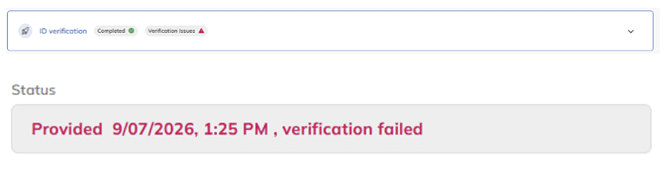
If this happens, continue to submit the loan application for our review.
Our team will:
- Determine if the application can proceed to assessment; or
- Whether additional identity verification will be required.
Equity Release / Cash Out
Equity Release / Cash Out Requirements
- Equity release / cash out is where a client refinances an existing mortgage secured by a residential property from another lender and wishes to maintain their existing available credit limit / redraw balance or wants to release equity from their property by way of a cash out component.
- Equity release / cash out is defined as funds derived from proceeds of an approved loan going directly to the client regardless of the purpose disclosed with the application.
- Clients will be required to provide evidence of the loan purpose for which the funds are to be used (i.e. copies of invoices, financial plans, contracts of sale, statements etc.) and this information is to be held on file.
- Where a component of the loan is equity release / cash out and the purpose is simply stated as “personal use (e.g. car, holiday)”, “home renovations” or “future investment”, then Granite will cap the cash out component to the lower of $200,000 or 20% of the security property value. Amounts greater than the capped amount will be approved on the condition that the funds are only released upon receipt of reasonable evidence for use (e.g., letter from financial planner, evidence of share or property portfolio, builder quotes or invoices for home renovations etc.)The following LVR restrictions apply to equity release / cash out:(i) > 90% LVR – cash out is not available
(ii) > 80% and ≤ 90% – limited to 20% of the security property value
(iii) ≤ 80% LVR – unlimited - Surplus funds are usually retained in the applicant’s loan account at settlement and are automatically available as redraw. Alternatively, funds can be release to the consumers linked bank account held with an ADI or a solicitors trust account for imminent property settlement.
Savings / Equity
Savings / Equity Contribution Requirements
- With most loans, the client must contribute some of their own money towards the purchase price. This is known as the consumer’s contribution. It is important to understand where these funds are coming from and to verify that the declared sources of funds are genuine. Where the LVR is greater than 90% then a minimum of 5% of the purchase price must be from the following acceptable sources of funds.
- Genuine Savings (excluding Professionals and Essential Workers per below).
- Federal and State Government Housing Grants (e.g. FHOG).
- Non-Refundable Gifts.
- Non-Refundable Builder / Developer Contributions.
- Approved Equity Share arrangements; and
- Approved Second Mortgage arrangements.
- Genuine Savings criteria can be waived for Professional and Essential Worker consumers that meet the following criteria.
(i) Maximum 95% LVR(ii) For Professionals as the main applicant, based on gross income, must be University Educated Professional and hold an Australian or Overseas University degree (Technology applicants may hold a TAFE or other industry Certificate).(iii) Professional consumers include, but are not limited to Lawyers, Certified Practicing Accountants, Dentists, Dental Specialists, Orthodontists, Obstetrician, Gynaecologist, General Practitioners, Hospital-employed Doctors, Medical Specialists, Anaesthetists, Paediatricians, Pathologists, Specialist Physicians, Psychiatrists, Veterinary Practitioners, Optometrists, Pharmacists, Chiropractors, Speech Therapists, Physiotherapists, Business Consultants and Information Technology Specialists, Executives and Managerial staff.(iv) For Essential Workers at least one applicant must be a Police Officer, Fire Fighter, Ambulance Officer, Nurse, Midwife, Nurse Educators, Paramedic, Border Force, Protective Services Officer, Assisted Carer, Primary, Secondary or Tertiary teachers.(v) Must be Australian Citizens or Permanent Residents with acceptable Visa living and working in Australia.(vi) Clean Credit (no arrears and no defaults).(vii) Maximum DTI of 6.0x.(viii) PAYG applicants must have been in current employment for a minimum 6 months.(ix) Self Employed applicants must have been established for a minimum of 24 months.
Genuine Savings
a. Genuine savings includes the following:
| Type | Requirements | Documentation |
|---|---|---|
| Equity in property | Must be held for at least 6 months in the consumer’s name | Title Certificates, Rates notice and loan statement (if applicable) |
| Sale of real estate | Property must have been in the name of at least one of the consumers | Contract of sale and evidence of net sale proceeds in savings account |
| Accumulated savings | Must be held or accumulated over 3 months in a savings account or term deposit in the consumer’s name | Bank statements within the last 3 months |
| Term deposit | Must be held in the consumer’s name for a minimum of 3 months | Bank statements within the last 3 months |
| Shares | Must be held over 3 months (publicly listed companies only) | Share Certificate |
| Superannuation Funds | Must be held in the consumer’s name | Copy of Superannuation statement confirming funds available for personal use |
Non-Genuine Savings
- The following are not acceptable as genuine savings.
- Additional borrowings where the LVR is greater than 90% (additional borrowings are acceptable provided that a minimum of 5% of the purchase price are from the acceptable sources of funds as outlined in section 8.
- Funds held in company / business accounts; or
- Barter money or trade dollars.
Funds to complete
- Residential Purchase (non-SMSF):
- LVR <=80%: Savings declared within the application are acceptable
- LVR 80% - 90%: Balance Statement confirming ownership adequate
- LVR >90%: Minimum of 5% Genuine savings required (refer to Genuine Savings)
- Residential Purchase (SMSF):
- Genuine savings required in all instances (refer to Genuine Savings).
Rental Payment History
- Where the LVR is greater than 90% and the genuine savings component of the consumers contributions do not meet the minimum time threshold then evidence of on time rental payments over the preceding 6 months is required.
Credit Card Limits
Credit Card Limits
Granite now relies on Comprehensive Credit Reporting (CCR) to verify credit card conduct, meaning the last 3 months of credit card statements are no longer required where at least 3 months of clear repayment history is visible on the CCR.
- In these circumstances, a standard servicing commitment of 3% of the credit card limit will apply.
Borrowers who wish to access a more favourable servicing treatment of 1.5% of the credit card limit are required to provide their last 3 months of credit card statements, demonstrating that the outstanding balance has been paid in full each month.
Credit card, store card and line of credit limits are required to be included in the loan servicing calculations. If the consumer has provided the last 3 months of card statements confirming that the card balance has been paid in full each month then the monthly commitment to be used in loan servicing calculations will be 1.5% of the limit.
Charge cards without a credit limit do not need to be included in the loan servicing calculations if the consumers comprehensive credit report or 3 months of card statements provides evidence that the card balance is paid in full each month.
Interest free / payment free loans normally provided by department stores for household appliances must be included in servicing for the new loan as the borrower will eventually need to make repayments at the end of the offer period.